Category: Uncategorized

  • How to Crochet a Negative Space Heart (That Actually Keeps Its Shape)

    Have you ever tried crocheting a shape that’s more space than stitches? Well, that’s what I set out to do here as I explore these negative-spaced gaps. While I usually focus on how yarn crafts intersect with other topics such as mathematics and programming, it’s just as helpful to understand how stitch structures behave on their own. If you’re someone who enjoys experimenting with stitch structure, shape, and size, then working with negative, cutout shapes could open up a whole new creative landscape.

    The inspiration behind the heart
    The design process
    So, what is a picot anyway?
    Trials and errors
    Where it went wrong
    Taking a better approach
    The finished product
    Lessons learned and future projects

    The inspiration behind the heart

    Around the time I started writing this post earlier this year, Valentine’s Day was looming just around the corner. So, I thought it would be fitting to try creating negative-spaced heart shapes. The heart shape is just one of many I’ve considered exploring, and now, I thought it would be a good time to try creating them in all their negative-spaced glory. Anything from butterflies to rectangles, each shape offered a chance to explore what yarn can do.
    Some perfect, some imperfect. Blocking usually counterbalances yarn irregularities or inconsistencies. Photo by Author.

    My primary objective for this project was to design cutout silhouettes that are structurally stable and maintain their form without requiring frequent adjustments. Well, I assumed that crocheting a series of openwork hearts would be quite challenging. However, after closely examining stitch dynamics, the process became much clearer.
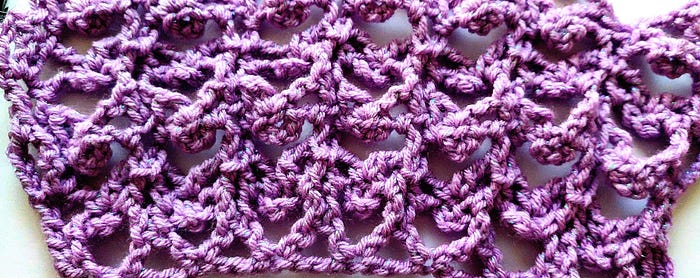
    Photo by author.

    I searched Google, Pinterest, TikTok, and other social media platforms to understand how the shape gets created. Surprisingly, I found very few results that matched what I was envisioning. Many of the results that returned for me were the large crochet cutouts commonly seen in sweaters, blouses, or showing as entirely different design schemes altogether. However, the more prominent options are just as stunning!

    It became clear that this specific heart cutout shape isn’t too prevalent in crochet, making it difficult to find a lot of direct references. However, in my search, I came across a couple of designs with structural similarities.

    I happened upon Wander and Create with Emma, whose beautiful pattern reinforced the idea that a series of cutout hearts embedded in fabric was possible. Even though I developed my own design, their approach provided valuable insight into the structure. ABCuteCreations also demonstrated a similar concept in a 2019 video, which helped me better understand possible the stitch arrangements. I experimented with my own method, but their work provided a helpful reference point.

    Ultimately, this heart cutout design was developed entirely through my own trial and error. I tested various stitch placements and anchoring techniques until I arrived at a method that worked for me in my design. Hopefully for whoever reads this, it works for you too!

    The design process

    This shape is quite simple to do. It involves a combination of treble stitches (or double crochet stitches for smaller hearts), chain stitches, and a picot stitch in the top center of an existing heart. All the stitches that make up the heart will join at a center point at the bottom (in an existing stitch). If you are familiar with the v-stitch pattern, that is major because the heart shape is simply that but with an additional step. Much like the tulip stitch, these hearts are an extended form of the v-stitch. This time with a picot thrown in midway.

    So, what is a picot anyway?

    A picot is a small loop created by chaining a certain number of stitches and then connecting them back to the main work or starting point. For additional information, there are many helpful resources available that further discuss how they work.

    Trials and errors

    A few challenges I encountered in making this pattern mostly centered around keeping the edges even, getting the right proportions, and maintaining structural integrity. There is a thin line between what was intended to be hearts and what became something else resembling a wobbly circle, a pair of lips of the human mouth, or some birds in flight. Take your pick.

    Original design:

    In my original design, a short picot chain and overly long side chains threw off the heart’s balance and shape. After creating the first treble crochet in any given chain, I followed this (wrong) sequence:

    • Made 1 treble crochet (tr) into the next stitch. This forms the right base of the heart.
    • If anchoring into an existing heart shape, place 1 half double crochet (hdc) into the right side (lobe) of the previous heart created one row below. This helps stabilize the shape.
    • Chain 4. This creates the right arch of the heart. (Note: This amount may be adjusted to prevent looseness depending on your yarn and tension.)
    • Create a picot: Chain 5, then place 1 single crochet (sc) into the 2nd chain from the hook. (This shorter picot creates a subtle point at the top of the heart.)
    • Chain 3 more, then place 1 sc into the 2nd chain, and chain 3 again. (Be cautious: excessive chaining can stretch the heart shape.)
    • Make another treble crochet (tr) into the same stitch as the first treble. This completes the left side of the heart.
    • Anchored the left side of the heart with 1 hdc into the left lobe of the previous heart wherever available.
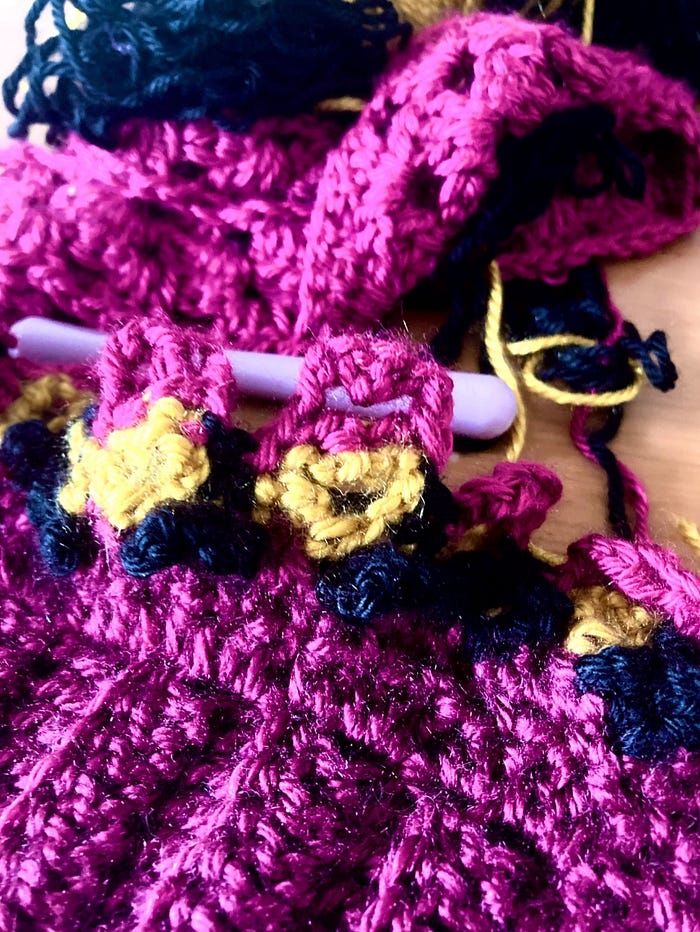
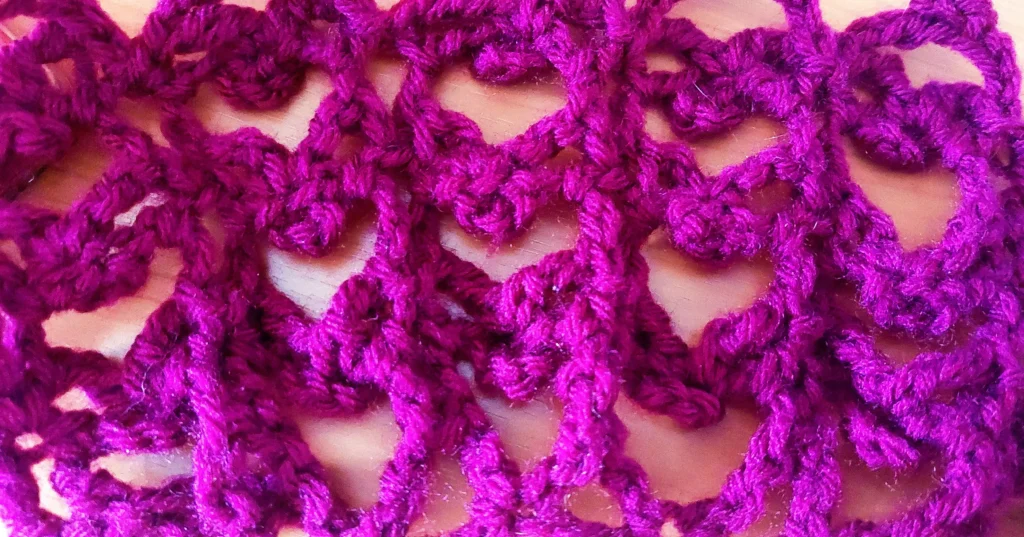
    These hearts try to become what they should be, but the choice of stitch is not reliable. Photo by Author.

    Sometimes, the heart puckered inward, puffed outward, or protruded from the back, creating an unexpected relief effect. This behavior is one of the “joys” of working with different yarn fibers… each one behaves uniquely based on its weight and composition.

    Yes, as you probably realized, the design can go sideways quickly.

    Where it went wrong

    It was primarily a few issues at play against the design:

    • An inconsistent number of stitches: At some point in that first attempt to design the stitch, I kept alternating between chaining three chains before the picot and chaining four after it.
    • Improper or Missing Anchoring: another issue with the original design arose from the absence of a method I call anchoring. What is anchoring? Anchoring is a way of molding the shape by ensuring that it holds its intended form with the help of stitches. I completed the step by placing stitches at different points along the shape. These stitches act as support points that guide and reinforce the structure, preventing distortion or collapse. Anchoring is similar to how support beams, columns, or pillars hold up parts of buildings.
    • Wrong stitch placement at the top: This one might be a bit of a nitpick on my part since you can place the heart in any available top stitch. Still, I noticed that positioning it in the most open space at the top affected how the shape looked.

    Here’s what those earlier missteps revealed about the process, and more importantly, how we can improve upon them.
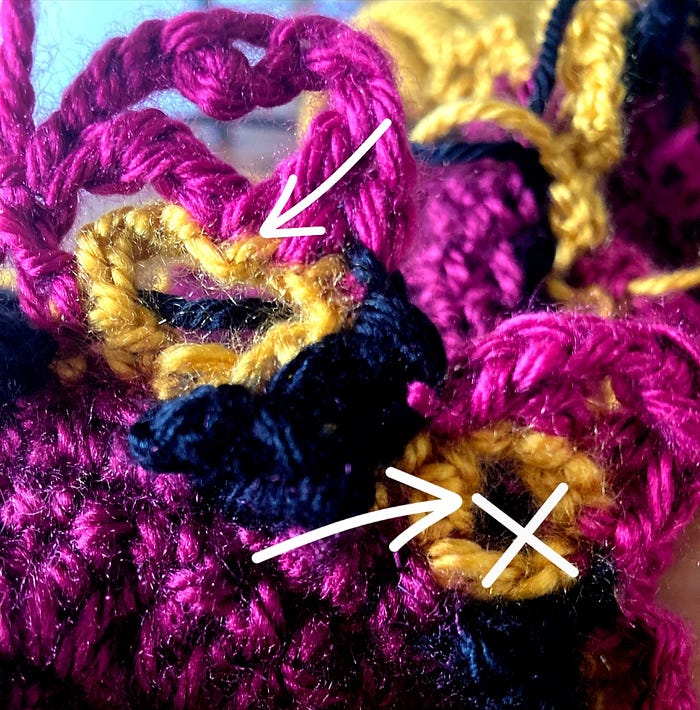
    The first attempt at creating a heart cutout. Somehow, one of the “hearts” became a circle along the way.

    Taking a better approach

    I now realize that open work heart shapes are some of the most fickle shapes to work with, but with the right approach, there is an effective way to create them.

    What I did differently to improve

    1. A more mindful stitch placement: to improve the design, I changed my approach by paying closer attention to where each stitch landed. I realized that even a slight shift in where I anchored a treble or chain could throw off the shape. By being more deliberate with my stitch placement, I was able to create a cleaner, more recognizable heart silhouette that held its shape better and looked more intentional.
    2. Better stitch offsetting: instead of allowing each heart to stand on its own with a stitch off to the side in the next stitch, it is easier to anchor them using half-double crochet stitches. I placed one half-double crochet stitch on the right side and another on the left side. This change in the design provided better balance and structure.
    3. Better anchoring at the top: When determining the optimal space, hole, or stitch to place the crochet heart in at the top of an existing heart, we can consider both the aesthetic flow and the structural balance of the design. I found that placing the new heart into an existing single crochet at the top helped ground it better.

    The final pattern

    • place 1 half double crochet (hdc) into the right side (lobe) of the next available heart
    • Make 1 treble crochet (tr) into a single crochet (sc) st at the top
    • In the same stitch as the previous treble crochet, chain 7
    • Skip 4 chains from the hook, and make 1 single crochet (sc) into the 5th chain
    • Make another treble crochet into the same stitch as double crochet and chain-7 picot just made, ch 2
    • Make 1 half double crochet (hdc) into the left side to form the left lobe of the heart

    There you have it!

    The finished product

    It’s one thing to create a test swatch of heart cutouts, but to make a hat filled with them is another animal entirely.

    The final product was — at the very least — presentable, but there was still room for improvement. Most importantly, what is intended to be a heart looked like one.
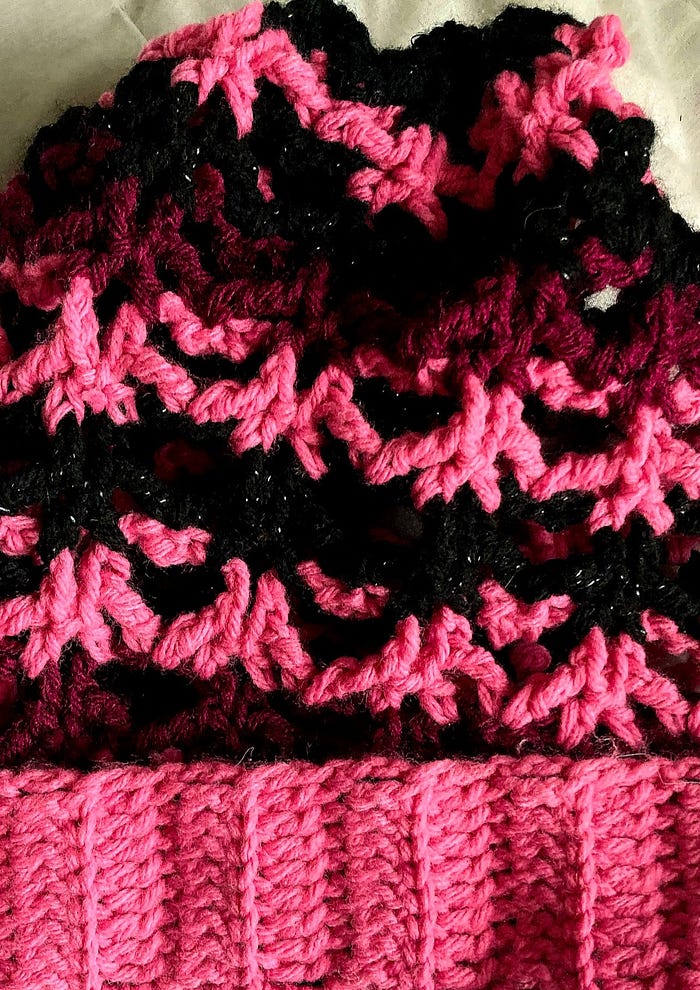
    Heart cutout hat that needs more work.

    Lessons learned and future projects

    Like most crochet projects, getting from idea to execution took more patience and tweaking than I expected. This is true for all endeavors to take off, and it’s especially true for crochet projects. The type of stitches used can really make or break the shape of our heart, or any other cutout shape, for that matter.

    Tying it all together

    Ultimately, this project reinforced how much stitch choice, yarn type, and tension will affect the final shape. The real challenge is getting the completed shape to maintain its form, but we can always find ways to circumvent yarn’s tendency to have a mind of its own through blocking!

    Nevertheless, once this stitch is mastered, it can be included in any pattern or design. I’m excited to keep refining my technique, and I hope this post encouraged you to experiment with cutout shapes too!

    If you’ve tried a similar technique or have tips for shaping negative-space designs, I’d love to hear your thoughts. Feel free to drop a comment, tag or share your experiences with this — successes and flops alike.

    Thank you for reading.

  • How Crochet, Math, and Code Fuse: Exploring the Amazing Butterfly Shape

    How Crochet, Math, and Code Fuse: Exploring the Amazing Butterfly Shape


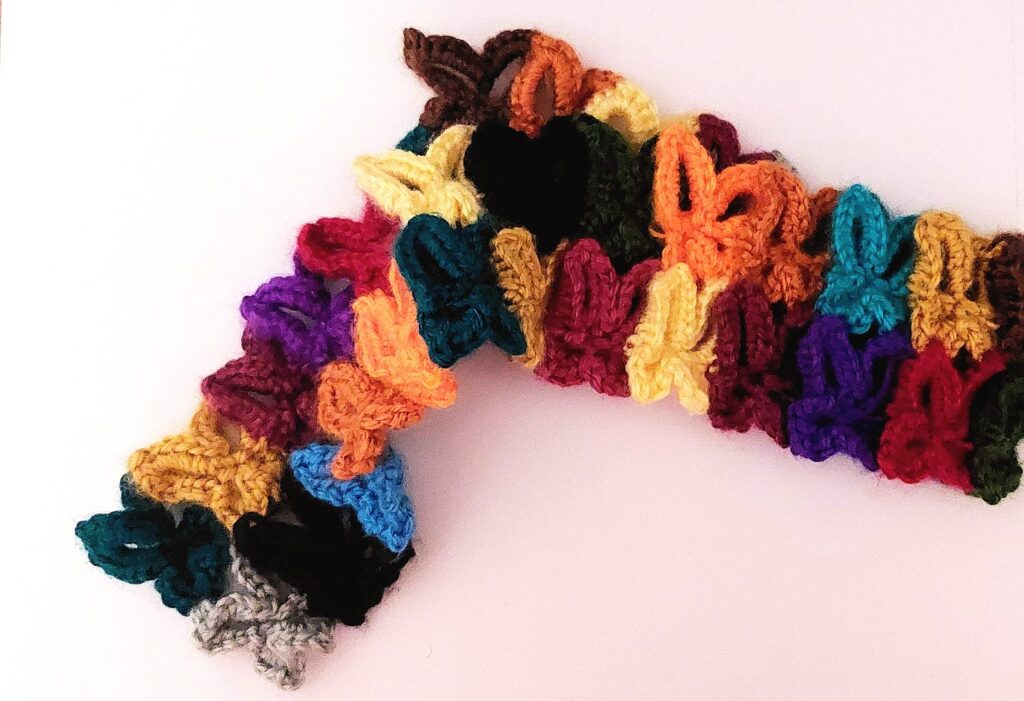
    A butterfly garland folded over.

    A Butterfly Garland

    @FiberArtsDecoded

    Table of Contents

    Exploring Crochet Through Code and Vice Versa

    A butterfly is more than a colorful form that flutters through the air. It’s also geometry in live form. A living proof of balance that manifests as one of the most eye-catching insects out there. Each wing mirrors the other with precision, shaped not just by genetics but by the logic underlying equations, algorithms, and stitches. Nature crafts them how a maker works with yarn: step by step, pattern by pattern, or until symmetry becomes second nature.

    This post is for anyone who’s ever thought math could be more approachable — especially when viewed through the lens of other mediums, like code and crochet. In this post, we continue our journey of visualizing math through art by exploring the butterfly curve. A polar equation that captures the symmetry of nature, giving these creatures their wings to fly.

    This is my personal way of connecting the butterfly curve to crochet techniques. It’s not a formal mathematical or crochet standard.


    How did the butterfly curve come about?

    The origin of the butterfly curve can be traced back to 1989. It was discovered by Fay H. Temple, and his findings were originally published in The American Mathematical Monthly. Art and science do not have to be mutually exclusive to appreciate an overlap, and Temple alludes to this, saying:

    “The classical rose curves and the like do not seem to provoke much student enthusiasm, but sketching more complicated curves, with the aid of a computer, seems to spark more interest and often brings surprises.”

    A look at the sinusoidal properties from trigonometry

    The butterfly’s shape shares mathematical traits with other complex patterns found in nature. Particularly, through the sinusoidal waves of sine curves. These wave-like elements create the curved edges of butterfly wings, all converging from a central plane. In my previous article, I wrote about the mathematical properties responsible for how roses form when they grow. For a deeper understanding of how these equations work, you can read more about other polar equation types here.

    This is denoted by the equation:

    Figure 1. The Butterfly Curve Equation

    Next, we look at how the butterfly curve combines exponential growth (exp(cos(t)), symmetry from cosine oscillations (-2 * cos(4t)), and fine detailing (sin⁵(t/12)) to create a shape that grows and contracts in a consistent way across all four quadrants. These mathematical terms together allow the curve to capture the symmetrical outline of butterfly wings, with both large-scale structure and intricate detail.

    You can graph the curve here on the Desmos calculator. This equation features three major parts inside the parentheses. Each term represents a different main section of the butterfly.

    Looking at the equation from the perspective of crochet

    Additionally, I thought it would be helpful to break down the equation into its respective zones on the coordinate plane. Specifically, we gain a clearer image by analyzing how the top, bottom, left, and right butterfly wings form. Then, we will examine this through the scope of a crochet project to better understand its real-life application.

    1. Defining the Butterfly’s Body

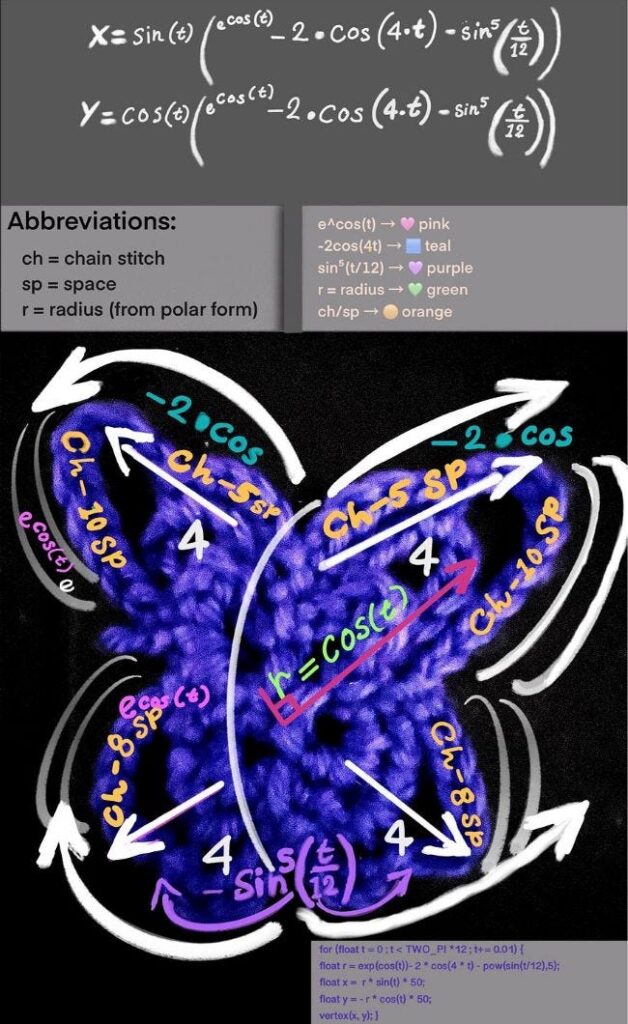
    The term e^cos(t) forms the central part of the butterfly anatomy. In crochet terms, it’s like creating a longer foundation chain that spans from the head down to the bottom to shape the body. 

    Figure 2. A hand-drawn diagram showing how the butterfly curve equation and computer code coincides with the different parts of a crocheted applique.’

    The letter e, also called Euler’s number, stands for the base of the natural logarithm. It essentially represents either growth or decay. For the butterfly curve specifically, it shows growth, acting like a volumizer of scale and adding fullness to the wings as t changes.

    2. The butterfly’s amplitude and symmetry 

    The term –2·cos(4t) amplifies the radius and shapes the butterfly’s wingspan. It acts like a stitch multiplier, controlling how far the shape stretches from the center. The 4t factor causes the function to repeat four times over a full rotation, producing a balanced, four-lobed symmetry. The factor of 4 in cos(4t) oscillates four times over a full rotation of a circle (0 to 2π), which directly contributes to the four-lobed symmetry of the butterfly. 

    In crochet, this mirrors how gauge and stitch pattern define the size and structure of a motif — where repeated stitch groups shape volume and a mirrored symmetry.

    3. Detailing

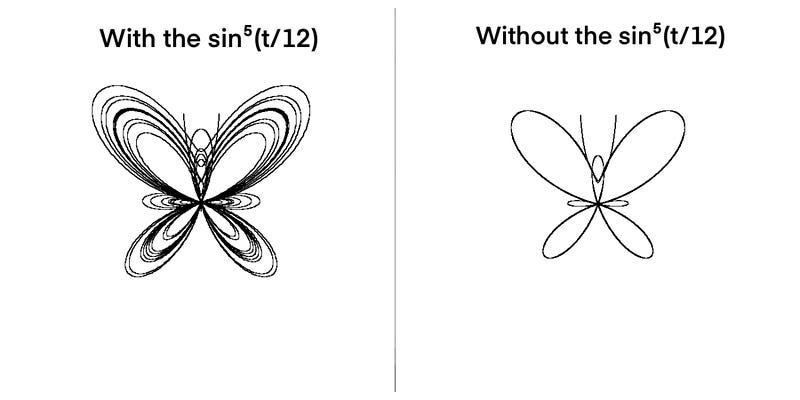
    The term sin⁵(t/12) is the part of the equation responsible for giving our digital butterfly its detailed properties. Without this term, the butterfly would appear as a basic butterfly outline. 

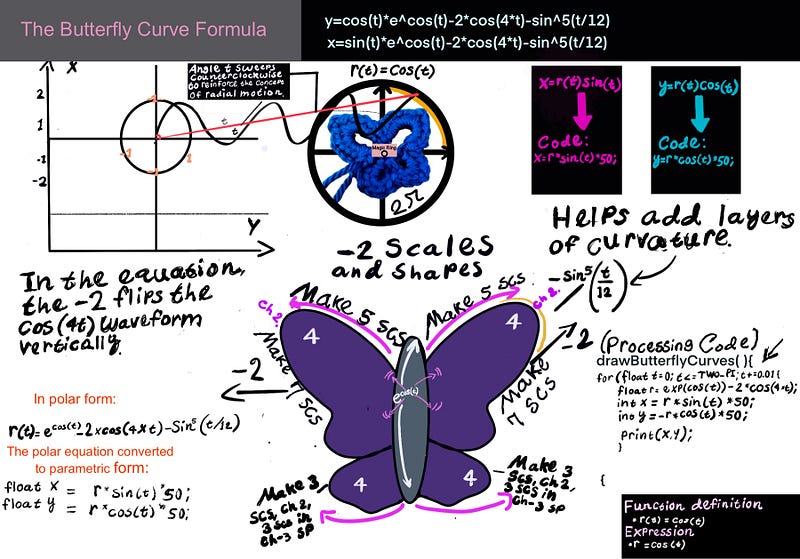
    Figure 4. Diagram showing the parametric Butterfly Curve in Processing & crochet

    This part makes the butterfly wings appear fine, with the ‘ripples’ resembling ridges along the edge of each wing. This part is comparable to the detailed work created within crochet projects, such as picots, frills, or edging.


    The Role of Sine and Cosine in Wing Formation

    The sine (sin) and cosine (cos) functions determine the respective y and x coordinates in a way that reflects their oscillatory behavior on a Cartesian plane. This means that these functions repeat in smooth waves, like the rise and fall of a swing or ocean waves. That repeating pattern helps draw the curved and symmetrical shape of the butterfly, as the input angle (in radians) varies.

    Moreover, we look a bit further into how the mathematical equation behaves within a programming environment.

    Visualizing with code: Math from the angle of programming

    Now that we’ve studied how mathematics shapes the butterfly curve, let’s examine how this comes to life in the Processing programming environment under the Java language. Code translates the math into motion, plotting each point as the equation unfolds over time.

    The for loop sets the variable t to an incremental value of 0.01, allowing the loop to step through the equation.

    Defining vs. Drawing: Polar Equations and Parametric Plots

    The butterfly curve is calculated in polar form — meaning the equation tells us how far from the center to go at each angle. However, to actually draw or render the butterfly, we need to convert the polar data into x and y coordinates, which is known as the parametric form. These coordinates let us plot each point of the curve in 2D space — whether on a screen, a graph, or a crochet project.

    x =  r * sin(t) * 50;
    y = -r * cos(t) * 50;

    Note: In Processing, the coordinate system is flipped vertically compared to the standard mathematical graphs — the y-axis increases downward from the top of the screen. As Daniel Shiffman explains in Learning Processing, this setup reflects how computer screens draw pixels from top to bottom. To account for this, we use -r·cos(t) for the vertical (Y) position instead of r·cos(t).

    (float r = exp(cos(t)) - 2 * cos(4 * t) - pow(sin(t / 12), 5);

    Incrementing the time

    The t+=0.01 in the for loop increments the angle slightly on each loop iteration, as it gradually moves through 12 complete cycles (or revolutions) around the unit circle. For t < TWO_PI * 10, the loop runs while t is less than 10 complete cycles of 2π (the usual range for periodic functions).

    for(float t=0; t <TWO_PI * 12; t+=0.01){
     //Here, variables are initialized to work with the t incrementor.
    }

    Each cycle of 2π radians is one revolution around the unit circle, meaning the loop traces 12 revolutions (12 times around the circle). This step ensures smooth curves happen by creating many small steps. You may think of it like a spirograph tracing loops: the more revolutions, the more detailed the final shape.

    In our program, two main functions represent the shape. The functions drawButterflyCurves() and drawAntennae() perform the task of drawing a butterfly shape. These functions execute in the main function void setup().

    The code that renders the butterfly in Java Processing:

    float x, y;
    float scale = 100;
    //Left butterfly Wing
    
    //Right butterfly wing
    
    void setup(){
      background(255); //Sets the background color of the canvas to white
      size(650,650); //Sets the width and height of the canvas
      
    }
    
    void draw(){
     //Moves the origin (0,0) to the center of the canvas. This is important because the rose is drawn using polar coordinates, which are centered around the origin.
      translate(width / 2, height / 2);
     //drawButterflyBody();
    drawAntennae();
    drawButterflyCurves();
     
     //ellipse(0,0,0);
    }
    void drawAntennae(){
      stroke(0);
      noFill();
      bezier(-1, -40, -15, -60, -25, -80, -30, -150);
      bezier(1, -40, 15, -60, 25, -80, 30, -150);
    }
    void drawButterflyCurves(){
      
      stroke(0);
      noFill();
      beginShape();
      for(float t = 0; t <TWO_PI * 12; t+=0.01){
      
       float r = exp(cos(t)) - 2* cos(4 * t)-pow(sin(t/12),5);
        x =  r * sin(t) * scale;
        y = -r * cos(t) * scale;
        vertex(x,y);
       
      }
      endShape();
      
    }
    • We use beginShape() to start defining a custom shape by plotting points. This function is always paired with endShape(), and together, they wrap around the code that calculates and places each point. Inside the loop, we use vertex(x, y) to add points based on the equation, and Processing connects them in order to draw the final shape. 
    • Again, as described a bit earlier, the statements in the program x = r * sin(t) * 50 and y = -r * cos(t) * 50 reference the Cartesian coordinates. The negative sign in y = -r * cos(t) * 50 flips the vertical orientation of the curve. 
    • In Processing, the y-axis grows downward, unlike standard math graphs. The minus sign flips the butterfly right-side-up, preserving its symmetry. Without this, the butterfly would appear upside down. If we hadn’t flipped the orientation, the butterfly would appear upside down. This is because the y-axis increases downward in Processing, unlike the upward-increasing y-axis in traditional Cartesian graphs.
    • Once again, the term exp(cos(t)) in the context of Processing causes the butterfly to scale dynamically, as if it’s breathing in and out—inflating and contracting along the curve. Much like how a crochet artist builds rows that expand or taper, this exponential term uses the wave-like motion of cos(t) to stretch the shape outward in some places and draw it inward in others, creating the illusion of a living, expansive form.
    • Similarly, pow(sin(t/12),5))—equivalent to (sin⁵(t/12))—raises a stretched sine wave to the fifth power, smoothing valleys and sharpening peaks. This adds refined ripple-like textures to the wings. Much like decorative stitch work in crochet.
    • In terms of the Bezier curve function values that set up the antennae, I suggest playing around with the values to determine what works and what doesn’t. Much of the process involves trial and error, and it’s a great way to practice!”

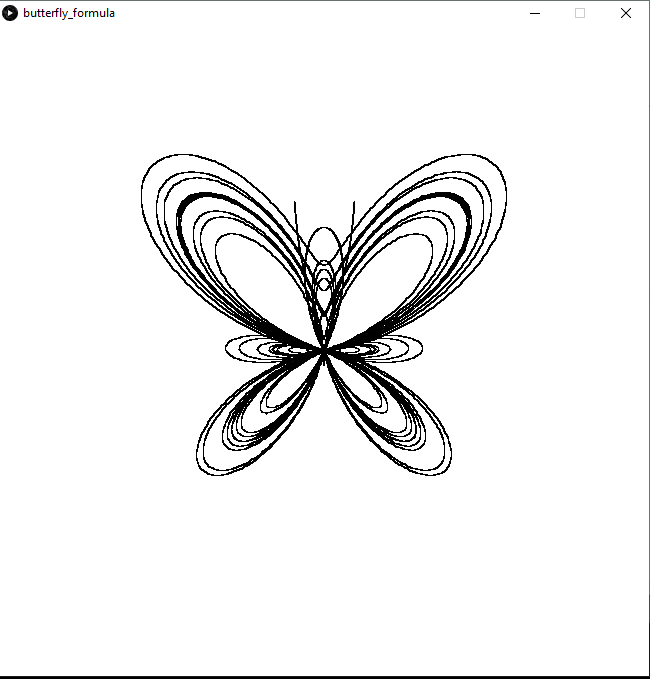
    Program Output

    Figure 5. Program output from the code.

    Try experimenting with the equation to see how each part shapes the curve. For example, I altered the equation slightly each time I ran the program to see what parts of it affected how the butterfly appeared.

    Here, I omitted the portion of the equation responsible for detailing (sin^5 (t/12)

    Figure 5. Program output showing how omitting a portion of the formula impacts the appearance.

    Translating Math Into Crochet

    Finally, let’s take what we explored through programming a step further. Here, we duplicate the results. Only this time, those results are put into physical form as crocheted items.

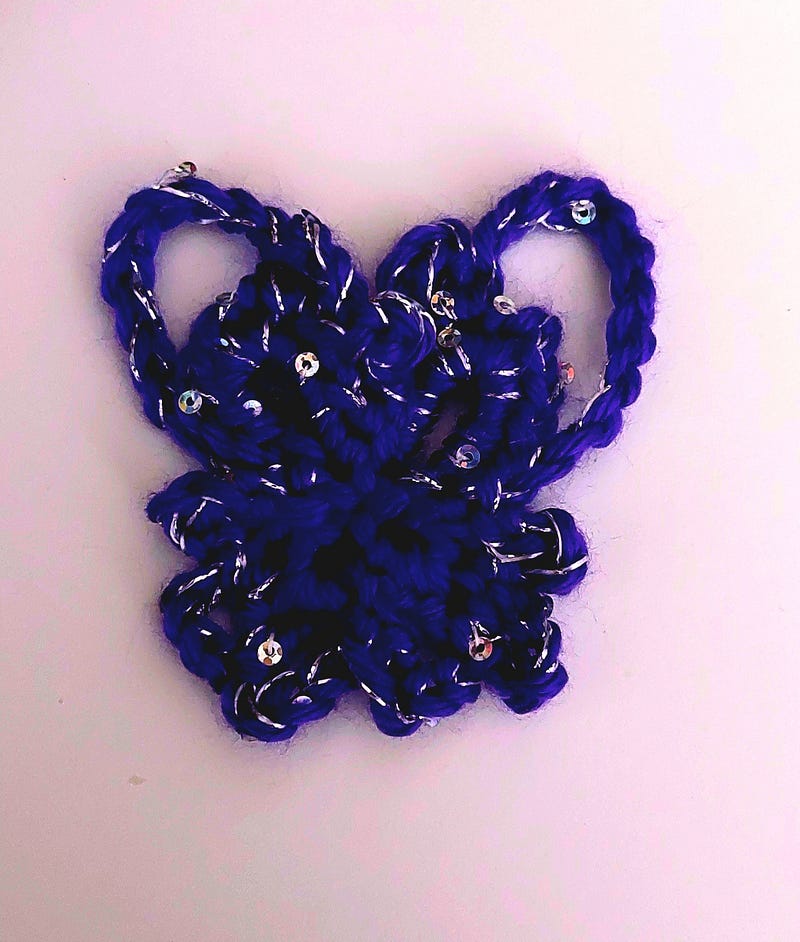
    Figure 6. Showing a more open outer wing design.

    In this way, each chain and slip stitch worked from the center helps form the butterfly’s body, mirroring the central part of the mathematical curve. The larger loops extending outward represent the prominent upper wings, while the smaller loops below correspond to the shorter, lower wings.

    Crocheting the butterfly appliqué

    This butterfly pattern starts with a magic ring (or a chain-space, alternatively) and builds out using just chain stitches. That’s pretty much all that’s needed to create the foundational outline of the butterfly. From there, it’s all about stitch choice, shape preferences, placement, and repetition to bring the wings to life.

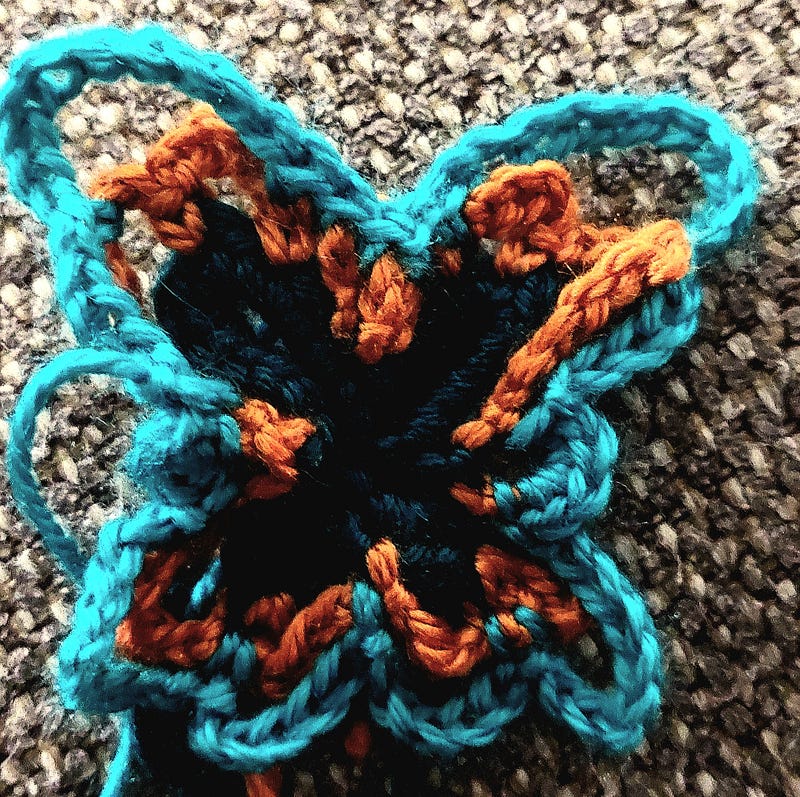
    Figure 7. An assortment of different butterflies showing a design that builds upon the foundational row of establishing a butterfly shape.

    I use crochet abbreviations like ‘ch’ (chain) and ‘st’ (stitch) throughout this example. But if you’re new to crochet or not yet familiar with these terms, you can find a complete list of abbreviations and their meanings, Crafty Yarn Council gives a more detailed list [here].

    Crochet Steps Summary:

    Like the butterfly in the equation or the programming environment, the crocheted butterfly follows the same fundamental logic: repetitive instructions done in a specific order to produce a recognizable shape. In this case, our chain stitches and structured loops work as replacements for variables and other types of control flow in the program. Yet, the essence is the same.

    1. Initialize the center:

    Using your crochet hook and yarn of choice, start with a magic ring or a loop to define the butterfly’s core. This creates the central point from which all symmetry extends.

    • Start Center: Magic ring or ch 3, join w/ sl st.

    2. Create foundational loops:

    We can create as many chains as needed for the bottom wings. Use these chain stitches to outline the axes of the wings. You may even think of these loops as scaffolding in the program or as the axis for the diagram.

    • Lower Wings: [Ch 3, sl st into ring] × 2.
    • Upper Wings: [6 sc into ch-7 sp, ch 2, 5 sc] × 2.

    3. Build symmetry through repetition:

    As we work our way from the center (magic ring), we fill in the wing outlines (chain spaces) by repeating any sequence of stitches with chains, single/double crochets to form the wings. 

    Figure. 8. A different butterfly variation showcasing the four-quadrant layout in the physical world.
    • Lower Wings: [3 sc into the ch-3 sp, ch 2, 3 sc] × 2.
    • Upper Wings: [6 sc into ch-7 sp, ch 2, 5 sc] × 2.

    4. Anchor at defined points:

    The slip stitches or joins from previous steps create new points upon which we can anchor new stitches. They return the sequence to the center or pivot points , creating closure and reinforcing the shape.

    • Anchor: Sl st between spaces that form the wings.

    5. Add optional decorative elements:

    On the third row, add more stitches and chain spaces to build upon the foundational butterfly shape. Use picots, puff stitches, frills, or shells to enhance each wing quadrant.

    • Decorate (Optional): Add picots, frills, puff stitches.

    6. Finalize the shape:

    Secure and fasten off, optionally adding antennae or border details. The resulting form resembles a natural butterfly and a plotted figure — symmetrical, modular, and shapes the typical outline.

    • Finish: Fasten off, weave in the ends, and add antennae, if desired.

    Closing the Butterfly Equation

    We explored how a single shape, the butterfly in this case, can transform across different contexts. Whether it is found in nature, drawn through mathematical equations, rendered in code, drawn on paper, or handmade with yarn, all versions are connected by the same underlying math.

    A Butterfly Garland

    When we look closer at the mathematical concepts playing out before us in the world and how shapes are formed, everything falls into perspective.


    Let’s keep exploring together!


    If you enjoyed learning about the connection between mathematics, butterflies, crochet, and code, don’t forget to follow me for more creative explorations.


    ❤️ Enjoyed this post? 
    🧶 Share with a fellow maker 
    ✨ Follow for more math-meets-craft stories 
    💬 I would love to hear your perspective on this topic. Tag me or comment below


    References

    • Fay, T. H. (1989). The Butterfly Curve. The American Mathematical Monthly, 96(5), 442–443. https://doi.org/10.2307/2325155
    • Libre Texts Mathematics. Polar Coordinates — Graphs: Goes over the different polar equations that exists other than the butterfly curve.
    • Wolfram MathWorld: Provides detailed information on the butterfly curve and its mathematical properties.

error: Content is protected !!